- Social Files by Tommy Clark
- Posts
- 🗃 The case for founder-led content
🗃 The case for founder-led content
Why it’s financially irresponsible not to publish your thoughts on the internet

Tommy Clark
December 01, 2025

Hey!
Welcome to Social Files—your no-BS guide to generating demand for your B2B product using social & content.
Hope you had a great holiday weekend. I’m back in Austin now after being home in LA for the past week, settling back into routine. Spent my weekend wrapping up Shadows Upon Time by Christopher Ruocchio. Masterpiece. If you're remotely interested in science fiction and fantasy, read the Sun Eater series. Just trust me.
Now, let’s chat marketing & content. 2026 is coming up fast.
You may be considering founder-led content as a core part of your marketing motion. Should you invest time and resources into it? Is founder content really worth it?
Let’s discuss.
Shall we?
🔎 DEEP DIVE
The case for founder-led content
Why it’s financially irresponsible not to publish your thoughts on the internet
Publishing my thoughts on the internet altered the course of my life, and my business.
I started posting online in 2018, when I was dabbling with an online fitness coaching business (as one does). Eventually, I realized I liked marketing that business more than running it—so I pivoted.
I started growing an audience on Twitter in 2020. Picked up a few freelance gigs. I was still in school at the time. And in December ‘21, right after graduating, I landed a job at a seed-stage startup in the ecommerce tech category by sending a cold DM to the CMO.
Keep in mind, I had never taken a marketing class (my degree was in Applied Nutrition), and I had no full-time experience as a social media manager (just a few freelance gigs). Also worth noting, I only had 2.5K followers at the time—by no means was I an ‘influencer.’
It gets crazier.
While at that job, I had success in my role and the company had success as a whole. And of course, I kept posting about it on Twitter. I started getting inbound from other SaaS founders asking me to help them. I had time on nights and weekends, and the side cash was nice, so I thought…why not?
About 1.5 years into the Head of Social job at Triple Whale, I found myself with a full client roster on the side. On accident. But really, it was because of my content. I made it easy for customers to find me—and to trust me.
So I left that job. Launched the agency. MRR on Day 1 was $25K. We’re 2 years into building Compound now, and we’ve more than quadrupled that revenue number. I’ve never once looked at my sales pipeline with concern. If anything, hiring to fulfill on the demand is the problem. A champagne problem, of course.
All thanks to content.
I am of the belief that every B2B founder should post content on the internet. There is no downside when you do it right. And no, you don’t have to be an ‘influencer’ (trust me, I would have stopped by now if that were the case).
Today, I’d like to make the case for founder-led content.
If you want to skim, and you don’t have time to read this whole thing, here’s the summary:
You’ll get more qualified leads. Those leads will close more often. You’ll have more authority with your prospects than any of your competitors. You’ll be more attractive to investors. You’ll also become a destination for top talent. You become defensible against PR crises. And you can scale this motion infinitely. The downside is that it’s often a slow burn for the first 3-6 months, and takes a ton of effort.
Okay, now for some more fleshed-out thoughts.
I’ll answer these questions for you in sequential order:
(1) Why post content at all?
(2) Why post founder content versus company content?
(3) What goes wrong when founder content doesn’t work for a company?
Why it’s financially irresponsible for tech companies to ignore content in 2025.
Reason 1: distribution is becoming one of the only moats left.
AI is making it easier and easier to build tech. When copycats can be created quickly, how do you make your startup defensible?
You need to be able to get in front of more customers than your competitors can—and you need to convince those customers to trust you better than your competitors can.
AKA - you need better distribution.
More distribution to a relevant audience means more pipeline for your company. It’s simple math.
You can pay for this distribution via ads—and that does work—but I think we can all agree that it’s getting more and more expensive to acquire customers in 2025.
The most straightforward way to accomplish this is by building an organic audience on platforms whee your target customers hang out. For B2B tech companies in 2025, this will be LinkedIn and X (more on platform selection here).
One cool part about this is that your organic presence will impact the performance of your paid efforts. When folks trust you and recognize you from the timeline, they will be more likely to engage with your paid media.
Reason 2: content is a salesperson who works 24/7.
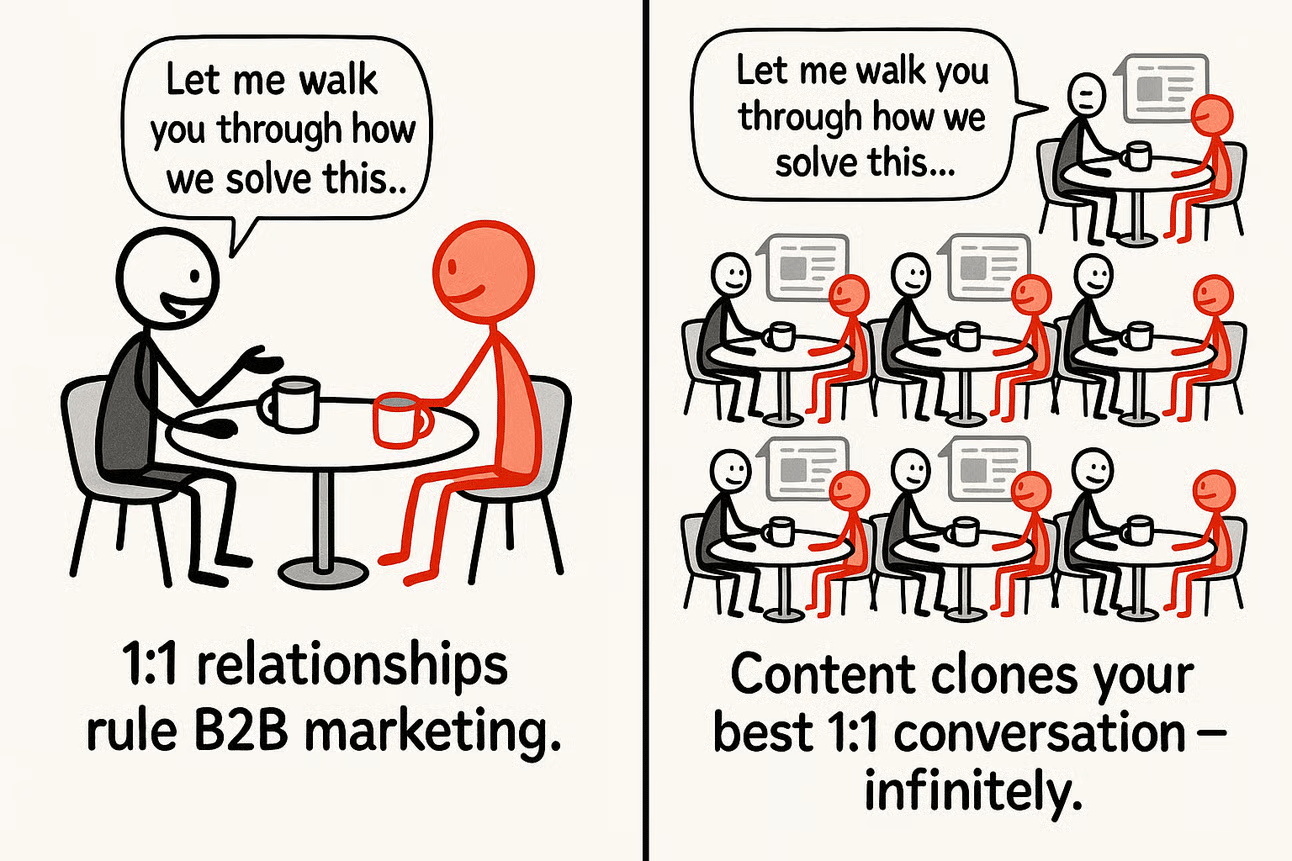
1:1 relationships rule B2B marketing. So many buying decisions are made off of recommendations from other people in similar roles.
Wynter surveyed 300 CMOs, CTOs and CFOs from $50M+ B2B SaaS companies. They found “75% of buyers turn to peers first when creating vendor shortlists, not Google.”
I’d imagine if you were able to sit down for coffee with a prospect, and explain the benefits of your product, you’d have an insane close rate.
Problem is, you can’t scale these 1:1 conversations. Say you packed your calendar with 30-minute sales conversations for twelve hours every day. That’s 24 conversations per day. 168 per week.
Content has those conversations for you 24/7/365. It communicates the exact message you want it to, every single time. It doesn’t need a day off for a ‘mental health day’ … lol.
You’re always in front of prospects. Always educating on the problem. Always overcoming objections. 168 ‘meetings’ can turn into 10,000…fast.
Even better, this content is evergreen. Sales conversations are ephemeral. When they’re done, they’re done. But that one LinkedIn post you created addressing the 3 most common objections you get in enterprise sales cycles can be sent to prospects ad infinitum.
In short: content is the only way to infinitely scale 1:1 conversations with buyers.
Oh, and your content “salesperson” also moonlights as a recruiter. The same patten plays out with hiring. You can do all the 1:1 outreach you want to candidates (and you should do this). But content can be a magnet for the A-players you want so badly to join your company.
Reason 3: most of your customers are not in-market at any given time.
In marketing, there’s this framework called the 95:5 Rule.
The premise is that only 5% of your customers are in-market at any given time.
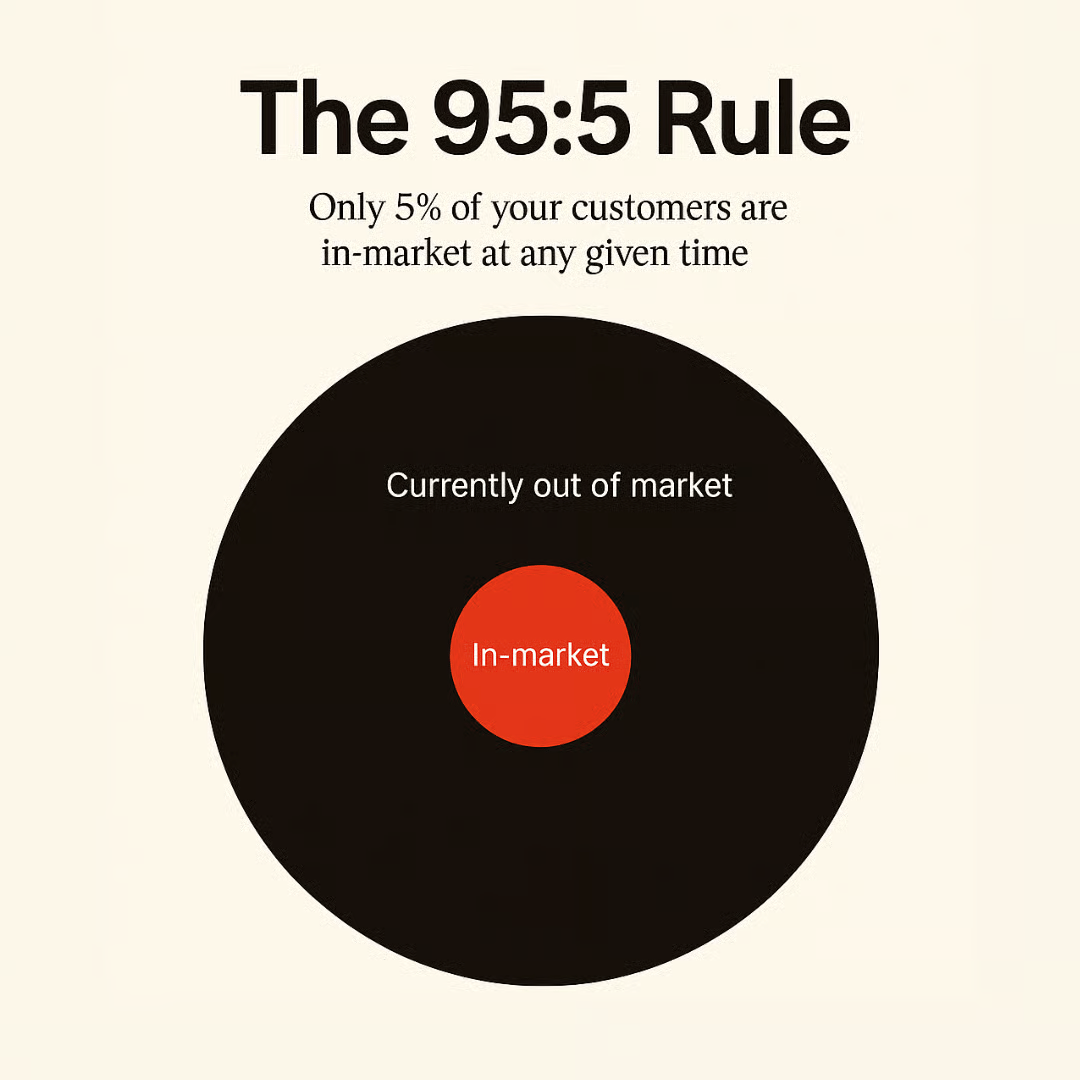
So many B2B companies spend their time and budget aggressively badgering the 5%. Product demos. Case studies. Hard CTAs.
I’d like to propose a different, potentially better, way to approach this.
Spend more resources building trust with the 95%. Then, when they become part of the 5%, your product is top of mind.
How do you do this?
I have a feeling you know what I’m going to say at this point…content. If you're showing up in front of your target audience every day when they refresh their LinkedIn timeline—who do you think they’re going to run to when they need something that you sell?
Content wins you the war for consumer mindshare.
The case for founder content.
Reason 1: the company account crisis.
Most founders who want to build distribution think they need to grow their company profiles. This worked in 2018. It doesn’t now.
Consumers are becoming blind to company content. The same sort of ‘banner blindness’ that people feel when being bombarded with ads has now found its way to branded content.
It’s a classic case of ‘marketers ruin everything.’ I believe we’re now out of the Golden Age of brand social because a lot of the content that comes from brands feels incredibly forced.
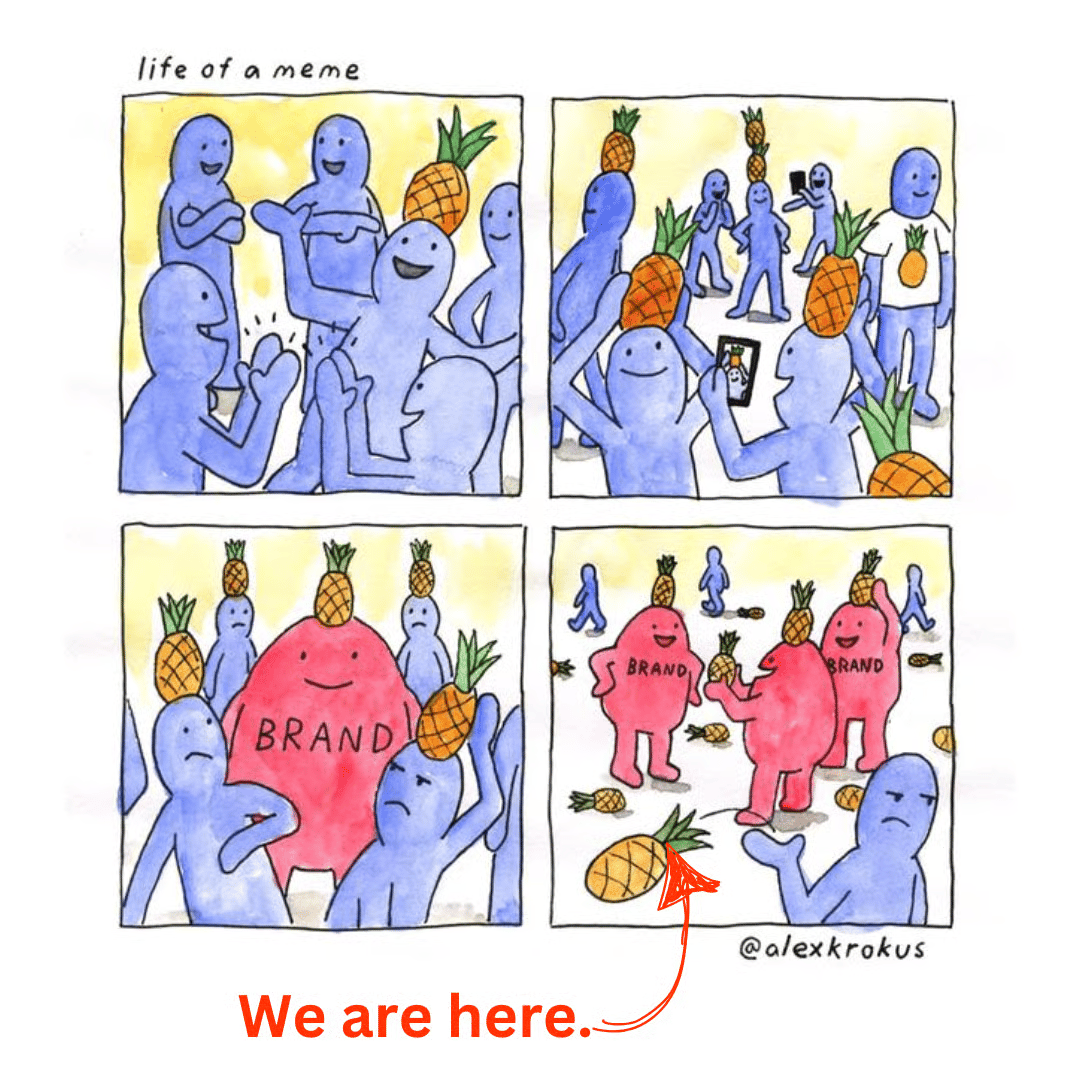
So, the performance of this content leaves a lot to be desired.
Think about how you consume content. Who do you follow on social? I’d be willing to bet large sums of money that you follow more people than you do companies.
This is especially true for early-stage and even growth-stage companies. You're not Airbnb. You're not Shopify. You're not Hubspot. Nobody recognizes your logo when they’re scrolling past one of your posts on the LinkedIn timeline. Yet, at least.
But your colleagues and industry connections recognize you—the person.
Even folks who don’t know you personally are more likely to engage with your content. There’s a phenomenon where YouTube thumbnails with faces get higher CTRs than those without. Same applies across most content formats.
You can either fight against this trend, or lean in.
And despite their brand recognition, larger, more established names in tech are going direct via founder content. Airbnb runs its feature releases through Brian Chesky’s social profiles. Shopify leaned on Harley and Tobi heavily for its 2024 BFCM campaign. ZoomInfo’s Henry Schuck is quite active on LinkedIn.
The list goes on.
A caveat: No. Company content is not completely dead. You can, and should, be active from your branded profiles. It just shouldn’t take priority over founder content.
I’m considering doing a write-up on how to produce company content correctly. If that sounds helpful, reply and let me know.
Parasocial interaction refers to a kind of “psychological relationship experienced by an audience in their mediated encounters with performers in the mass media, particularly on television and online platforms.”
It can have a bit of a negative connotation. You probably hear the term and think of the chronically online teenager who genuinely believes their favorite Twitch streamer is their best friend.
But hear me out. We can use this phenomenon for the good of society (to maximize shareholder value for B2B tech companies, duh).
We just established that people consume, and engage with, personal content more than corporate content.
Now, when they read, watch, and listen to this content, they feel like they know you.
Again, just think back to your own behavior patterns here. I want you to picture of the host of your most-listened-to podcast.
You probably know stuff about their personality and their life that you would know about a friend. You probably agree with their point-of-view on the world and their work. You probably trust their recommendations for products and services.
Scott Galloway said that when a fan stops him in public and starts talking to him as if they’re already friends, he knows they’re a podcast listener.
This plays out in B2B marketing plenty.
I’ve been on several sales calls where I have to do no selling. The call is a formality, because the prospect already knows how I think—they’ve watched 3 hours of my YouTube content and see me on their LinkedIn timeline every day. They understand my approach and my personality.
I recently had a prospect show up to a sales call ready to sign a $15K per month deal before I even pitched. It’s surreal.
Parasocial relationships also make hiring top talent easier.
I was talking to a client of ours last week. She runs a Series B software company. She told me a recent candidate said to her in an interview, “it feels like I already know you.”
Like my client, I’ve also seen content impact recruiting. I always ask candidates, “what made you want to apply at Compound?” Over 50% of the time, the response is something like “I saw a post you made about [core value] and it resonated with me. Candidates read your stuff.
The converse is also true: founder content repels bad cultural fits. Chris Hladczuk, posts often on X about how his team at Hanover is in the office, absolutely cracked out at 9pm and on weekends. I’m sure some people find this insufferable. That’s his goal. He doesn’t want to hire those people. He wants to attract the psychos who find that schedule appealing.
It’s like a Rorschach Test for your hiring pipeline.
Think about how different the ‘vibe’ is in conversations driven by content compared to starting completely cold.
Cold outbound is like going up to a stranger in Times Square and asking them for money. Founder-led marketing is like sitting down with a friend to update them on your project. Night and day difference.
You can create this feeling. A parasocial relationship is not accidental. Content is what’s responsible for it.
Founders get hesitant about this because they know it works, but they don’t want to be influencers. They just want to build a great company. The idea of unnecessary attention sounds horrible to them. I’m with you.
Good news: you don’t need to play that game. You can build a killer business with a moderately-sized LinkedIn audience. Shaan Puri says is better to be “known well” than “well known.”
You also don’t need to share personal information you’re not comfortable with. You get to choose how much you share online. Gary Vee shares how he dreams of buying the Jets with his tens of millions of followers, but you never see any family content on his profile. I call this Strategic Personal Content, and I wrote more about it here.
The ideal level of internet fame is enough that you’ll get pulled aside at a niche industry conference, but not enough that you get stopped on the street.
Reason 3: punch above your weight class.
Content creates a ‘reality distortion field’ around your company.
It often makes you seem bigger than you are. Early on, this is an advantage.
Like it or not, companies with more hype get access to investment opportunities and higher-quality talent. To be clear, I’m not suggesting you go 2020-era Fast here and pull out the jet skis…just that more distribution tends to unlock better growth opportunities.
In his 2024 Year in Review, Unify co-founder Austin Hughes wrote, “we’re consistently beating thousand-pound gorillas in our category with more money, bigger teams, etc…One of the drivers of this has been the brand we’ve built around Unify.”
That ‘brand’ was largely driven by founder-led LinkedIn content.
Another example of content bending reality is the hype around beehiiv, an ESP competing in the same category as $1.2B behemoth, Mailchimp.
Their CEO, Tyler Denk, writes a weekly newsletter called Big Desk Energy and publishes frequently on LinkedIn & X. He shares a lot of behind-the-scenes info. Tyler credits ‘building in public’ for being able to raise a $2.6M seed round in 7 days.
I even see this with Compound. We’re still ‘early,’ only 2 years in. But we’re winning deals against some bigger names.
Even during 2023, earlier in the journey, my personal brand gave off an aura of momentum—in reality, the ‘company’ at the time was me and a few contractors.
Reason 4: you just get luckier.
Think of every piece of content you publish like a lottery ticket.
That post could be the one piece that gets in front of your dream investor. It could move a stalled enterprise deal across the finish line. It could attract your next 10x employee.
A few examples of how this has played out for me:
Remember, I landed a dream job because of my Twitter content. I would not be here today if not for my chronic online writing habit.
Another one. One of my favorite Compound clients came inbound after reading my LinkedIn posts and my newsletter. He was sold before he got on the call. We’ve been working together for almost a year, and has been a joy to work with—not to mention our account with him has expanded.
Had I not been posting, I would have missed out on this perfect-fit client.
The cool part about the content lottery is, you can buy infinite tickets—for free. And…you can rig the odds in your favor.
You can get better at writing hooks. You can better understand how to use visuals in your content. You can develop a better grasp on trending topics. There are countless ways you can give yourself a better shot at landing on some magic internet luck. All of this is in your control.
Another helpful analogy for your content is that it’s a magnet. And that magnet is finely tuned to pull on: potential customers, great-fit investors, 10x team members…you get the point.
Sure. You could do a bunch of outreach to people you’d like to meet. Or…you could post targeted content that attracts those people for you.
According to Ben Sharf, co-founder of Platter, “most of my largest opportunities came from people I didn’t even know followed my content.” When you rely only on cold outreach, you miss out on opportunities you didn’t know existed.
Building in ‘stealth’ multiplies your level of luck by zero.
When founder-led content goes wrong
A successful founder-led content motion requires intrinsic motivation from the founder.
Your content agency can’t want it more than you. Your Head of Marketing can’t want it more than you. You—the founder—need to take content seriously.
I’ve started disqualifying Compound prospects if I chat with their Head of Marketing in a sales call and hear something like, “Yeah, John hates the idea of posting content from his account, but we know we need to do it to generate leads.”
With that attitude, you're not going to generate the leads you want. Clients like that churn after 2 months because “LinkedIn doesn’t work.” No, you don’t work.
Look at every ‘successful’ founder on the social timeline—Adam Robinson, Austin Hughes, Alina Vandenberghe to name a few—what do they have in common?
THEY LIKE CREATING CONTENT. Shocker. I know.
Even the founders who work with an agency or have a team producing their content do enjoy content. They just don’t have time to do it all themselves. Austin is a prime example here. He’s a Compound client—one of our best.
The reason why he’s one of the best is that he participates in the process. He shows up to Content Interviews. He proposes his own content ideas. He gives actual feedback on the content we send over. He’s stuck with it for over a year. I hope you see this is not random.
Same goes for Adam Robinson. He was an early client of Compound. I convinced him to start posting on LinkedIn. He had a lot to learn, but he was down from Day 1. Now, he spends 20+ hours per week writing his own stuff, because he enjoys it.
I’ve been writing for 7 years. I’d write every day, forever, even if I didn’t get paid. Intrinsic desire.
Content is too hard to do if you don’t like it enough. It takes too long. It’s like building a company. Only psychos with a high pain tolerance do that.
Ok. So what’s the ROI?
You're a founder. Not a starving artist. So naturally, we gotta talk about the money.
This entire essay is a long-winded way to say founder-led content will net you more revenue. It’ll also get you more access to capital, if you're going the VC route.
You'll get more leads.
You’ll have a higher closing percentage with those leads.
You’ll drive more traffic to your website.
You’ll see better performance across adjacent marketing channels—paid media, cold outbound, events, etc.
If you want the nerd version of this, I wrote a full essay breaking down founder-led content success metrics here.
Just press publish.
I want nothing more than to convince you to publish your first piece of content.
That will be an inflection point for your company—and for your life. Posting my first piece of content on my fitness Instagram page was a ‘butterfly effect’ moment that led to me running a 7-figure agency 7 years later.
Content compounds.
And trust me, you “have the time.” I like this reminder from Exit Five founder, Dave Gerhardt:
“I don't believe that these people [founders] don't have the time to write - because those same people are writing in Slack, email, Wiki, and Google Docs all day. They can find ways to turn this into LinkedIn content.”
If I’ve convinced you, I’d recommend reading this essay next. I’ll walk you through how to stand everything up the right way—so you don’t need to spend the next year entirely on trial and error.
Last thing: could you forward this article to a founder who needs to post more content? My mission is to get more tech founders posting online. I’d appreciate that 🙂
🗃 FILE CABINET
Here’s my favorite marketing and business content I bookmarked this week.
How Businesses Win LinkedIn's NEW Algorithm by Tommy Clark 🎥
The best LinkedIn content strategy for early-stage SaaS by Tommy Clark 🎥
How to Write Something Truly Memorable by David Perrell and David Grann 🎥
Check these out.
BEFORE YOU GO…
As always, thanks for allowing me into your email inbox every week.
More from Social Files:
Talk soon,
Tommy Clark